
ACORD™ 130
Workers Compensation
Get to know the ACORD™ 130 — the essential form for Workers Compensation coverage and a key step in submitting complete commercial insurance applications.
A fully completed application is required.
PAGE 1
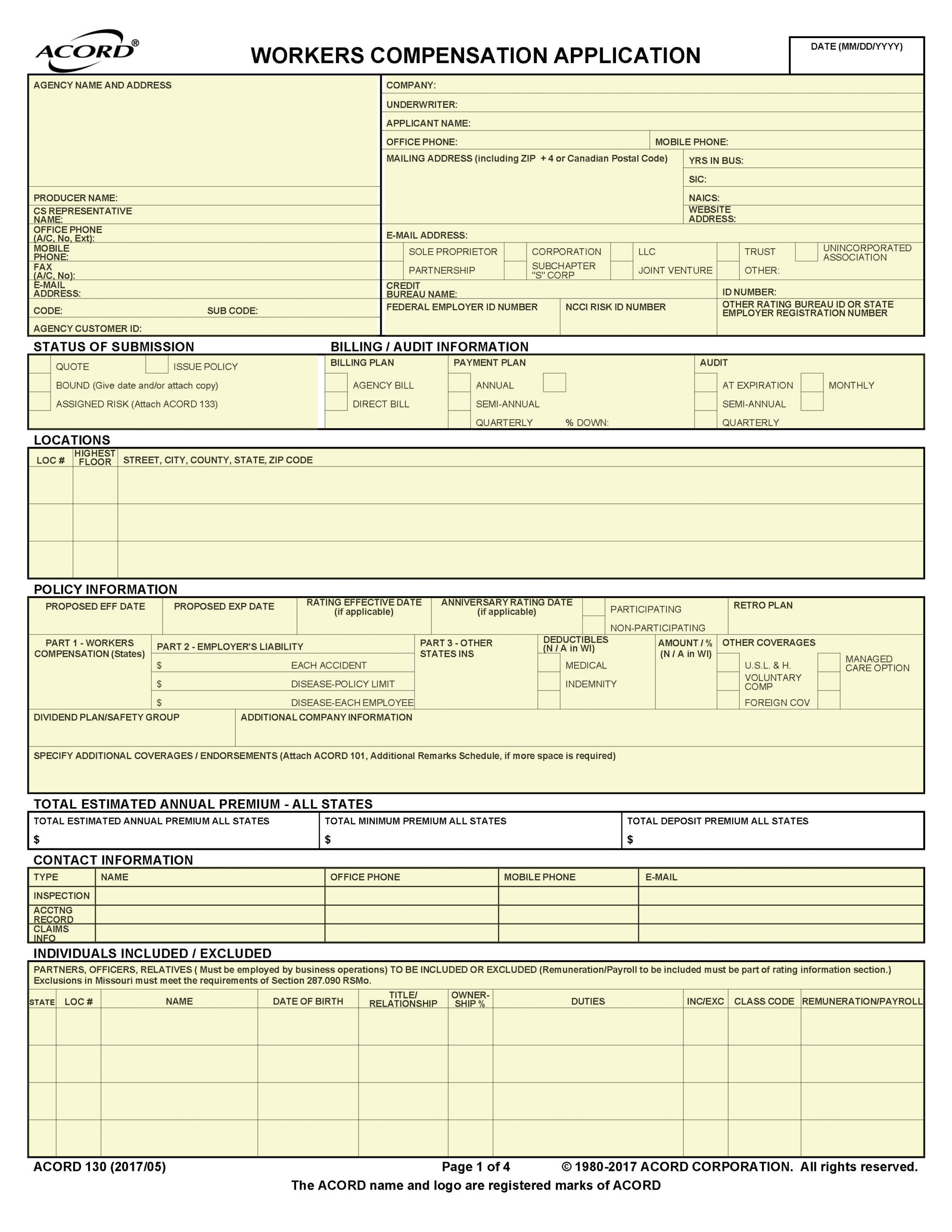
Form Key
1. Agency Producer Information
Enter the name of agency/producer, Contact Name, Phone Number, Fax Number, Email address and Agency Code.
2. Applicant Information
Enter the applicant’s name as it should appear on the policy declarations. Enter the applicant’s office phone #, mobile phone #, mailing address, years in business, website address, email address, type of business entity and federal employer ID number (FEIN).
3. Status of Submission
Check the appropriate box for the type of submission.
4. Billing/Audit Information
Check the box for the desired billing and payment plan
5. Locations
Enter the location number and the physical location address for the location.
6. Policy Information
In this section, provide the proposed policy effective and expiration dates, Workers Compensation states to be covered, employers liability limits, and other coverage/endorsement information.
7. Contact Information
Provide policyholder contact information for inspection, audit, and claims purposes. Include contact name, phone numbers and email addresses.
8. Individuals included/excluded
WC regulations vary by state. Depending on the state, partners, officers or relatives may be included or excluded from coverage. Use this section to provide detailed information on any individual to be voluntarily included or excluded. Provide their name, date of birth, title/relationship, ownership %, duties, class code and payroll and whether they should be included or excluded.
PAGE 2
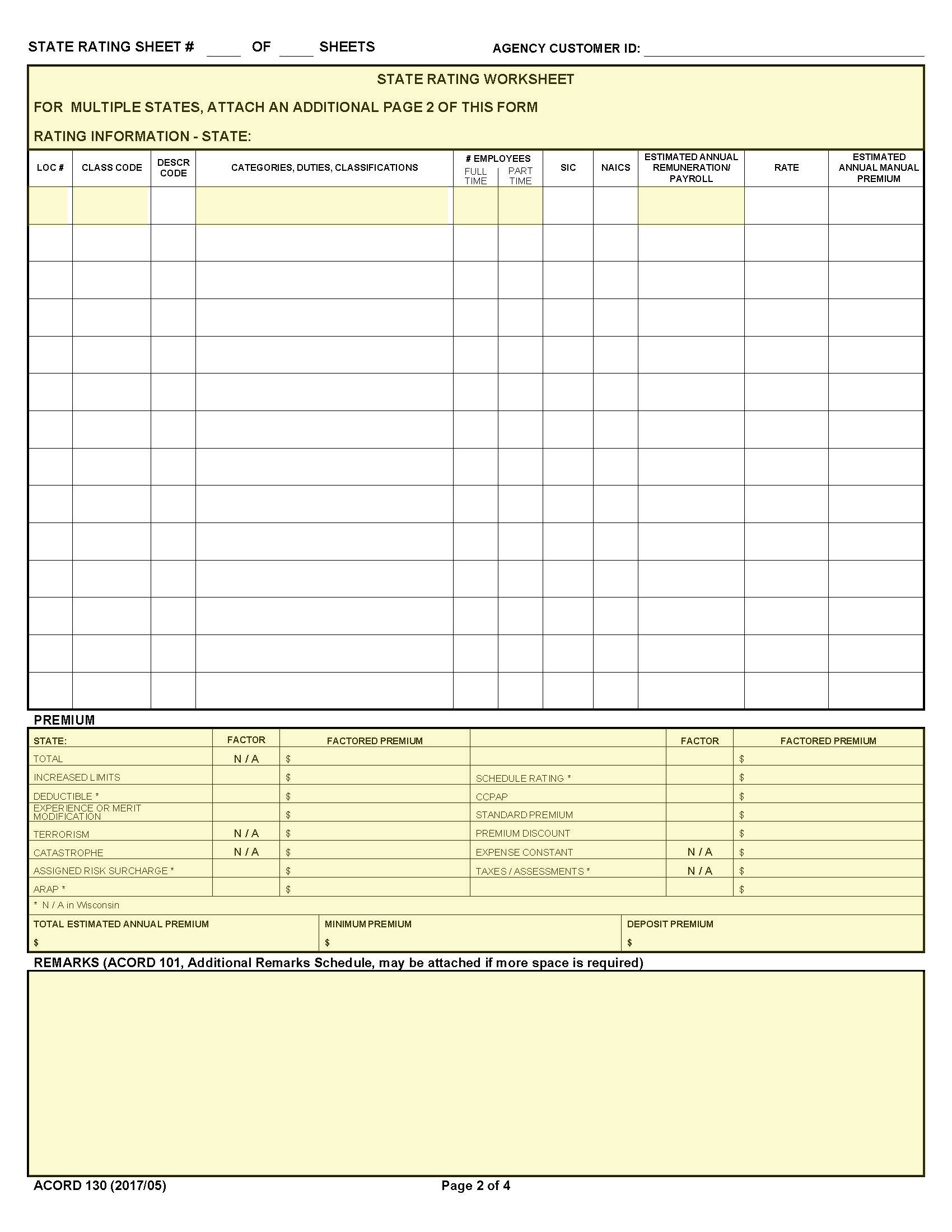
Form Key
1. State Rating Worksheet
For multiple states, attach an additional page 2 of this application.
2. Loc #
Provide the location number associated with the classification.
3. Class code
Enter code: The Rating Classification Code is a six-digit alpha-numeric code obtained from the National Counsel on Compensation Insurance (NCCI) Workers Compensation and Employers’ Liability Insurance Manual. Only suffixes specifically shown on rate pages may be used.
4. Categories, Duties, Classifications
Enter the descriptions of activities and operations. One class code may include several descriptions. It is extremely important to enter the specific classification description or, at least, a brief statement regarding the duties of the employees. Enter as much information as necessary to avoid misclassifying the operations.
5. # of employees
Enter the number of full time and part time employees to whom the classification applies. The average number is sufficient when the total number fluctuates during the year. Underwriters use this number to determine if the payroll estimates appear adequate.
6. Estimated Annual Remuneration/payroll
Enter amount: The estimated total annual remuneration/payroll for the class. Remuneration/Payroll means money or substitutes for money, such as the value of meals or lodging if provided. Accurate payroll estimates help avoid additional premium requirements being discovered during an audit. Do not include overtime premium.
7. Premium
Not required. Premium will be determined by the Company.
8. Remarks
Enter the remarks associated with the state. ACORD 101, Additional Remarks Schedule, may be attached if more space is required.
PAGE 3
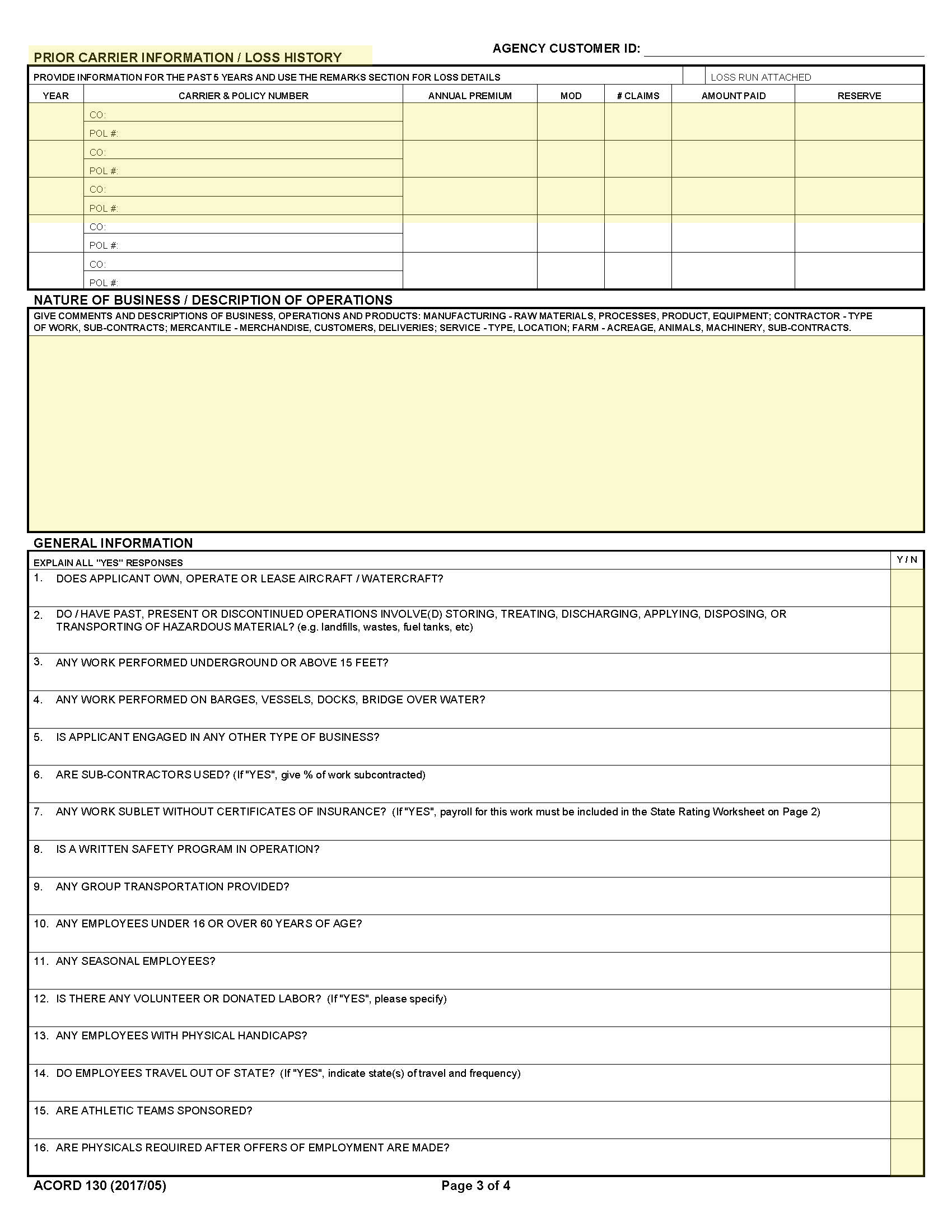
Form Key
1. Loss Runs Attached
Check the box (if applicable): Indicates a loss run is attached to this application.
2. Prior Carrier Information/Loss History
Provide prior carrier and loss history for the past 5 years. Use the remarks section for loss details. Provide the year the policy became effective, name of the prior carrier, prior policy number, annual premium, mod, # of claims, amount paid and reserved for that policy term.
3. Nature of business/description of operations
Provide a detailed description of the business, operations and products. If manufacturing include raw materials, processes, product and equipment. For contractors include type of work, sub-contracts. For mercantile include merchandise, customer, deliveries. For service include type, location. As used here, this section informs the underwriter of each applicant’s business and the way it is conducted by premises. Operations, which may not be apparent in a general description, may be segmented by location.
4. General Information
Answer all questions as they pertain to the applicant’s business operations. Explain all yes responses and refer to your underwriter before binding coverage. Note that Merchant’s is not a market for risks involved in handling or transporting any hazardous materials, Any risk doing work above 3 stories or underground work more than 12 feet, any work performed on barges, vessels or over water, risks who subcontract more than 40% of their work, and risks who regularly use casual or day labor.
PAGE 4

Form Key
1. General Information (continued)
Answer all questions as they pertain to the applicant’s business operations. Explain all yes responses and refer to your underwriter before binding coverage.
2. Signature and date
The applicant’s and producer’s signatures are required along with the date the application is signed.